
- Visit our Location
Mulund, Pune, Nashik, Hyderabad,
Andheri, Kandivali, Mumbai, Vashi,
Navi Mumbai, Kalyan, Nagpur - Operating Hours
Monday – Sunday: 9AM – 7PM
Wednesday: Holiday - Give us a Call +91 9004726844 / +91 9920936844
- Send us an Email office.anssi@gmail.com
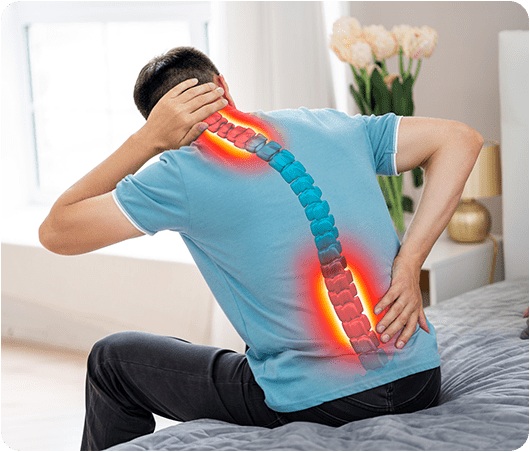
Spondylosis
A very common spinal problem experienced by people worldwide, spondylosis is basically osteoarthritis of the spine. It’s a degenerative disorder which might lead to the loss of normal spinal structure & function in a person.
Symptoms
Spondylosis is known to affect specific areas of the spine, such as the neck (cervical), mid-back (thoracic), or lower back (lumbar) region. Depending on the spinal region it affects, the following are the common spondylosis symptoms:
Neck (Cervical) Region
- Neck pain radiating into the shoulder or arm
- Weakness in the arm, hand or wrist due to nerve root compression by a bone spur
- Issues in swallowing food as a result of a bone spur on the cervical spine (in rare instances)
Mid-Back (Thoracic) Region
- Pain in the mid-back area that is felt after bending a joint forward or hyperextending a joint
Lower Back (Lumbar) Region
- Pain & stiffness in the joints after waking up in the morning
- Pain experienced after doing a physical activity or sitting at a place for a long time
- Rise in pain after doing activities like bending & lifting repetitively
Causes
Spondylosis can be caused by a wide array of factors. However, out of them, the following are the three main spondylosis causes:
Degeneration Caused By AgeingAge-related wear & tear is the leading cause of spondylosis. As we age, water levels in the spinal discs drop, resulting in them shrinking, getting herniated/bulged and contributing to spondylosis.
Repetitive Usage & OveruseEngaging in physical activities that involve constant bending and leaning down can cause regular muscle strains, culminating in spondylosis over a period of time.
Direct TraumaTrauma due to a fall/accident can contribute to spondylosis by causing injuries to the spine and its neighbouring tissues. The inflammation during the initial period of the injury can cause wear & tear, joint enlargement, and other problems linked with spondylosis.
Diagnosis
In individuals showcasing spondylosis symptoms, an enquiry regarding the symptoms followed by a physical examination can help a doctor get a brief idea of the condition.
The healthcare professional can then prescribe imaging tests such as an X-ray to check for changes in spinal bones and/or an MRI or CT scan to examine detailed images of the spinal discs. The X-ray could also be conducted to inspect the skeleton while in motion, such as when bending the neck/spine forward or backwards.
These diagnostic scans can help identify issues like herniated/bulging discs and bone spurs, which may be causing nerve root compression by narrowing the spinal canal.
Treatment
Overcome Your Spondylosis with the 100% Non-Surgical Spinal Decompression Treatment!
ANSSI’s USA-patented technology for Non-Surgical Spinal Decompression Treatment has successfully treated 3500+ patients suffering from various spinal disorders without surgery.
Backed by the USA Journal of Clinical Research, it’s much better than other treatment options like surgery, steroid injections & painkiller medications due to the following benefits:
- 100% Non-Surgical Treatment
- No Medicines or Injections
- No Hospitalisation
- No Side Effects & Faster Recovery
- No Post-treatment Physiotherapy
- Safe without Risks linked with Surgery/Anesthesia
- Lifelong Pain Relief at Fraction of Surgery Cost
- Proven & Patented Technology Since 1994
- Helped Avoid 3500+ Surgeries Globally
- Effective as per USA Journal of Clinical Research
Backed by Prominent Medical Research Facilities


- 100% Non-Surgical Treatment
- 3500+ Surgeries Avoided
- >85% Recovery Rate
Benefits of Non-Surgical
Spinal Decompression Treatment
 100% Non-Surgical Treatment
 No Medicines
 No Injections
 No Hospitalisation
 No Side-effects
 No Post-treatment physiotherapy
 Lifelong Pain Relief at
Fraction of Surgery Cost Helped Avoid 3500+
Surgeries Globally Safe without Risks linked
with Surgery/Anesthesia Proven & Patented Technology
Since 1994 Effective as per USA Journal of
Clinical Research

